
Sri
Gauranga
Ashram
Home
| The enigmatic life of Sri Krishna Chaitanya |
Om Vishnupad 108 Tridandi Swami Sri Srimat Bhakti Sravan Tirtha Goswami Maharaj ki Jai !!
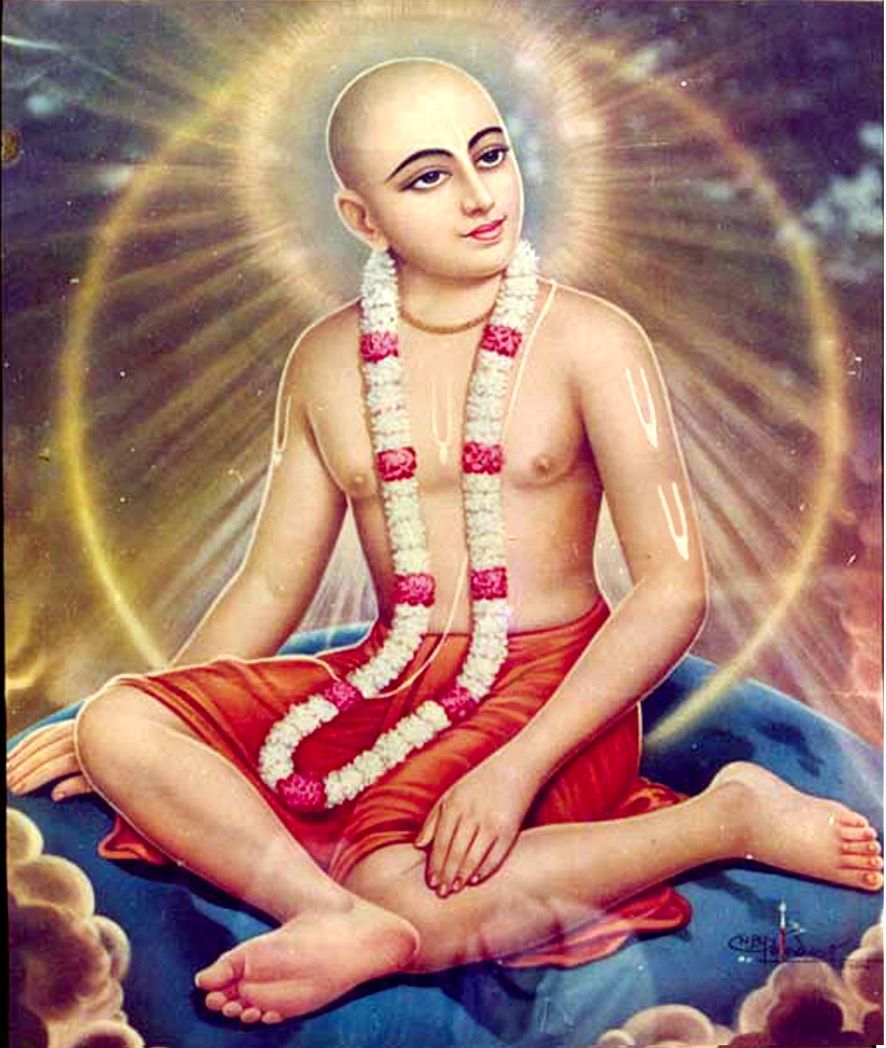 Chaitanya Mahaprabhu was born in Mayapur in the town of Nadia just after sunset on the evening of the 23rd Phalgun (1407 Sakadba), corresponding to the 18th of February 1486 of the Christian Era.
It was the festival of Holi and the full moon was eclipsed at the time of His birth. As is usual during eclipses, the people of Nadia were immersed in the waters of the Ganga chanting the names of God ‘Hari Hari!’ . Thus at the time of Mahaprabhu’s advent, the “Naam” was also born.
His father, Jagannatha Mishra and His mother, Sachi-devi, both descended from Brahmin stock originally residing in Sylhet. Mahaprabhu was a beautiful child, very fair and with large eyes and the ladies of the town came to see Him bearing presents.
His maternal grandfather, Pandit Nilambara Chakravarti, a renowned astrologer, drew up the infant’s natal chart and foretold that the child would be a great personage in time; and he, therefore, gave him the name Vishvambhara.
The ladies of the neighbourhood styled him Gaurahari on account of His golden complexion, and His mother called Him Nimai on account of the neem tree beneath which He was born.
Being an attractive child everyone heartily loved to see Him every day. As He grew up He became a precocious and restless boy. After His fifth year, He was admitted into a pathasala or school where He picked up Bengali in a very short time.
Most of His contemporary biographers have mentioned a number of anecdotes of Sri Chaitanya which record His early miracles. It is said that when He was an infant in His mother's arms He would cry loudly, and when the neighbouring ladies sang 'Hari Hari bol…' He would stop. Thus there was almost continuous utterance of 'Haribol' in his house.
Once when he was just crawling around, a brahmana on pilgrimage stayed as a guest in His house, and cooking his own food offered it to Krishna in meditation. In the meantime the lad came and ate up the cooked rice. The brahmana, astonished at the child’s act, cooked again at the request of Jagannatha Mishra. The child again ate up the cooked rice while the brahmana was offering the rice to Krishna with meditation.
The harassed brahmana was persuaded to cook for the third time. This time all the inmates of the house had fallen asleep, and so the lad showed Himself as Krishna to the traveller and blessed him. The brahmana was then lost in ecstasy at the appearance of the object of his worship.
Another time a couple of thieves stole away the boy from His father's door with a view to purloin His jewels and gave Him sweetmeats on the way. The lad exercised His illusory energy and tricked the thieves into wandering round and round ultimately landing back near His own house! The thieves, thoroughly confused and afraid of being caught, left the boy there and fled.
Another miraculous act that has been described is Nimai’s demanding and getting from Hiranya and Jagadih all the offerings they had collected for worshiping Krishna on the day of Ekadashi.
When only four years of age He toddled up and sat on a pile of soiled cooking pots which were considered unclean by His mother. When entreated to get off, He explained to His mother that there was no question of clean or unclean as regards to earthen pots thrown away after the cooking was over. Since they were made up the five basic elements – earth, water, fire, air and ether – they were essentially the same stuff that everything in the world was composed of. These anecdotes relate to His tender age up to the fifth year.
In His eighth year, He was admitted into the ‘tol’ of Gangadasa Pandit in Ganga nagar close by the village of Mayapur. In two years He became well read in Sanskrit grammar and rhetoric. His readings after that were of the nature of self-study in His own house, where He had found all-important books belonging to His father, who was a learned pandit himself. It appears that He read the 'smriti' in His own study, and the 'nyaya' also, in competition with His friends, who were then studying under the celebrated pandit Raghunatha Shiromani.
Now, after the tenth year of His age, Vishwambhar became a passable scholar in grammar, rhetoric, the 'smriti' and the 'nyaya'. It was after this that his elder brother Vishwarupa left home in order to become an ascetic. Nimai, though a very young boy, consoled His parents, saying that He would serve them with a view to please God. Soon after that, His father passed away. His mother was devastated and Mahaprabhu, with His usual contented appearance, consoled His widowed mother.
At the age of 14 or 15 Vishwambhar was married to Lakshmipriya, the daughter of Vallabhacharya, also of Nadia. He was at this age considered one of the best scholars in Nadia, then renowned seat of 'nyaya' philosophy and Sanskrit learning.
Now a married householder, He went to eastern Bengal on the banks of the Padma to teach and earn wealth. There He displayed His learning and obtained a good sum of money. It was at this time that He preached Vaishnavism at intervals.
After teaching him the principles of Vaishnavism, He instructed Tapan Mishra to go to and live in Benares where He (Mahaprabhu) would meet him later on. During His residence in East Bengal, His wife Lakshmidevi passed away due to snakebite. On returning home, He found His mother in a mourning state. He consoled her with a philosophical talk on the uncertainty of human affairs and stoically bore the tragedy.
 It was at His mother's repeated entreaty that He married again to Vishnupriya, the daughter of Raj Pandita Sanatana Misra. His comrades joined Him on His return from his travels. He was now considered to be the best pandit in Nadia.
Keshava Mishra of Kashmir, who had called himself the Great Digvijayi, came to Nadia with a view to debate with the the learned scholars of that place. Afraid of the so-called conquering pandit, the scholars of Nadia left their town on pretence of invitation. Keshava met Vishwambhar at the Barokona-ghata in Mayapur, and after a very short discussion with Him he was defeated by the boy. Nimai Pandita was now the most famous Pundit of His times.
At the age of 16 or 17 He travelled to Gaya with a host of His students and there took His spiritual initiation from Ishwar Puri, a Vaishnava sannyasi and a direct disciple of the renowned Madhavendra Puri.
Upon His return to Nadia, Nimai Pandit turned religious preacher and His religious nature became so strongly manifest that Advaita Acharya, Srivasa and others who since before the birth of Chaitanya were already famous as devout Vaishnavas, became astonished at the change in the young man. He was then no more a contending 'naiyayika', a wrangling 'smaarta' and a criticizing rhetorician. He wept tears and swooned at the name of Krishna and behaved as an inspired man under the influence of His religious sentiment.
It has been described by Murari Gupta, a class-fellow and eye-witness, that He showed His divine powers one night in the house of Shrivasa Pandit in the presence of hundreds of His followers, who were mostly well-read scholars. It was at this time that He opened a nocturnal school of 'kirtana' in the compound of Shrivasa Pandit with His intimate associates. There He preached, sang melodiously and danced in rapture, and there He expressed such a degree of spiritual sentiment as had never been seen by those men before.
Nityananda Prabhu, who was then himself an Avadhut or mystical saint of Vaishnavism and who had then completed His travels all over India, joined Him at that time. In fact, a host of learned preachers of Vaishnavism, all sincere at heart, came and joined Him from different parts of Bengal. Nadia now became the regular seat of a host of Vaishnava acharyas whose mission it was to spiritualize mankind with the highest influence of the Vaishnava creed.
The first mandate that He issued to Prabhu Nityananda and Haridasa was to “..go through the streets of the town, meet every man at his door and ask him to sing the name of Hari with a pure heart and then come back and report to Me every evening the result of your preaching.” Thus ordered, the two preachers went out and met Jagai and Madhai, two most abominable characters.
They insulted the preachers on hearing Mahaprabhu's mandate, but were soon converted by the influence of devotion inculcated by their Lord. The people of Nadia were now surprised. They said, 'Nimai Pandit is not only a great genius, but He is certainly a missionary from God Almighty.'
From this time to His twenty-third year, Mahaprabhu preached His principles not only in Nadia but in all important towns and villages around His city. In the houses of His followers He manifested miracles, taught the esoteric principles of 'bhakti' and sang the holy Name with other devotees.
His followers in the town of Nadia started to sing the Holy Name of Hari in the streets and bazaars. This created a sensation and roused different feelings in different quarters. The 'bhaktas' were highly pleased. But the orthodox priests became jealous of Nimai Pandit's success and complained to the Muslim Kazi about the character of Chaitanya as being un-Hindu.
The Kazi came to Shrivasa Pandit's house and broke a 'mrdanga' ('khola' drum) there and declared that unless Nimai Pandit ceased to make noise about His queer religion he would be obliged to enforce Mohammedanism on Him and His followers.
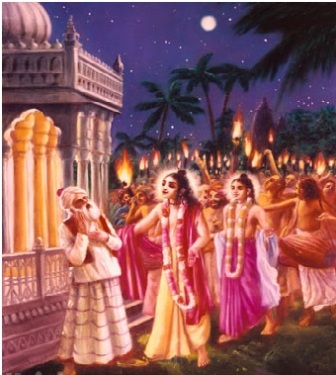
This was brought to Mahaprabhu's attention. Undaunted He ordered the townspeople to gather in the evening each with a flaming torch in his hand. This they did, and Nimai marched out with His chanting party divided in 14 groups. On His arrival at the Kazi's house, He confronted the terrified Kazi and held a long but polite conversation with the Kazi and in the end communicated into his heart His Vaishnava influence by touching his body. The Kazi then wept and admitted that he had felt a keen spiritual ‘current’ which had cleared up his doubts and produced in him a religious sentiment which gave him the highest ecstasy. The Kazi then joined the sankirtan party. The world was astonished at the spiritual power of the Great Reformer, and hundreds and hundreds of heretics converted and joined the banner of Vishvambhara after this miracle.
Some time after this a few of the jealous and low-minded brahmanas of Kulia picked a quarrel with Mahaprabhu and collected a party to oppose Him. Nimai Pandita was naturally a soft-hearted person, though strong in His principles. He thought a great deal about this development and realised that party feelings and sectarianism were the two greatest enemies of progress and that as long as He should continue to be an inhabitant of Nadia belonging to a certain family, His mission would not meet with complete success.
He then resolved to be a citizen of the world by cutting His connection with His particular family, caste and creed, and with this resolution, in the 24th year of His life, He embraced the order of a sannyasi at Katwa, under the guidance of Keshava Bharati, a renounced ascetic of that place. He was given the name Krishna Chaitanya – He who awakens Krishna consciousness.
His mother and young wife wept bitterly at His separation, but Chaitanya comforted them and revealed to them His mission. He left His little world in His house for the unlimited spiritual world of Krishna.
After His sanyas, Sri Chaitanya decided to head off towards Vrindavan but He was induced to visit the house of Advaita Prabhu in Shantipura. Advaita managed to invite all His friends and admirers from Nadia and brought Sachidevi to see her son.
Both pleasure and pain pierced her heart when she saw her son in the attire of a sannyasi. As a 'sannyasi', Krishna Chaitanya wore nothing but a 'kaupina' a loin cloth and a 'bahirvasa' (outer covering). His head was shaven clean, and His hands bore a 'danda' (stick) and a 'kamandalu' (hermit's water pot).
The Holy Son fell at the feet of His beloved mother and said, "Mother! This body is yours, and I must obey your orders. Permit me to go to Vrindavan for My spiritual attainments." The mother, in consultation with Advaita and others, asked her son to reside in nearby Jagannath Puri so that she might obtain His information now and then.
Mahaprabhu agreed and in a few days left Shantipura for Orissa. His biographers have described the journey of Sri Chaitanya in great detail. He travelled along the side of the Bhagirathi as far as Chatrabhoga, situated now in Thana Mathurapura, Diamond Harbour, 24 Parganas.
There He took a boat and went as far as Prayaga-ghata in the Midnapura District. Thence He walked through Balasore and Cuttack to Puri seeing the temple of Bhuvaneshvara on His way. Upon His arrival at Puri He beheld the deity of Lord Jagannatha, and sang and danced in such ecstasy that everyone was spellbound.
Sarvabhauma Bhattacharya an intellectual giant of the day saw this young man and was at once attracted as well as concerned for him. He was astonished at the personal beauty of His form and feared that it would be difficult for the young man to maintain 'sannyasa-dharma' (celibacy) during the long run of His life.
The Bhattacharya’s brother-in-law Gopinath, who had known Mahaprabhu from Nadia, had a great reverence for Him and declared that the young monk was not a common human being. On this point Gopinath and Sarvabhauma had a hot discussion. Sarvabhauma then requested Mahaprabhu to hear his recitation of the Vedanta-sutras, and the latter tacitly submitted.
Chaitanya heard with silence what the great Sarvabhauma uttered with gravity for seven days continously, at the end of which the latter said, 'Krishna-Chaitanya! I think You do not understand the Vedanta, for You do not say anything after hearing my recitation and explanations.' The reply of Chaitanya was that He understood the sutras very well, but He could not make out what Shankaracarya meant by his commentaries. Astonished as this, Sarvabhauma said, 'How is it that you understand the meanings of the 'sutras' and do not understand the commentaries which explain the 'sutras'? All well! If You understand the 'sutras', please let me have Your interpretations.'
Mahaprabhu then explained all the 'sutras' in His own way without touching the pantheistic commentary of Shankara. The keen intellect of Sarvabhauma saw the truth, beauty and harmony of arguments in the explanations given by Chaitanya and obliged him to utter that it was the first time that he had found one who could explain the Brahma-sutras in such a simple yet authentic manner. He admitted also that the commentaries of Shankara never gave such natural explanations of the Vedanta-sutras as he had obtained from Mahaprabhu. He then submitted himself as an advocate and follower. Soon thereafter Sarvabhauma turned out to be one of the best Vaishnavas of the time.
When reports of this came out, the whole of Orissa sang the praise of Krishna Chaitanya, and hundreds and hundreds came to Him and became His followers.
In the meantime Mahaprabhu thought of visiting Southern India, and He started on the journey by foot accompanied by an attendent. His biographers have given a detailed account of the journey. He went first to Kurmaksetra, where He performed a miracle by curing a leper named Vasudeva. He met Ramananda Rai, the Governor of Vidyanagara, on the banks of the Godavari and had a philosophical conversation with him on the subject of 'prema-bhakti'. He worked another miracle by touching (making them immediately disappear) the seven 'tala-trees' through which Lord Ramachandra, the son of Dasharath, had shot His arrow and killed the great Bali Raja.
He preached Vaishnavism and 'nama-sankirtana' throughout the journey. At Srirangam He stayed for four months in the house of one Venkata Bhatta in order to spend the rainy season. There He converted the whole family of Venkata from Ramanuja Vaishnavism to Krishna-bhakti, along with the son of Venkata, a boy of ten years named Gopal, who afterwards came to Vrindavana and became one of the six Goswamis or prophets serving under their leader Sri Krishna Chaitanya. Trained in Sanskrit by his uncle Prabodhananda Saraswati, Gopal wrote several books on Vaishnavism.
Sri Chaitanya visited numerous places in Southern India as far as Cape Comorin and returned to Puri in two years by via Pandharpur on the Bhima. In this latter place He spiritualized one Tukarama, who became from that time a famous preacher himself. This fact has been admitted in his songs called ‘abhangas’.
During His journey He had several discussions with the Buddhists, the Jains and the 'mayavadis' in several places and converted His opponents to Vaishnavism.
Upon His return to Puri, Raja Prataparudra-deva and several pandit brahmanas joined the banner of Chaitanya Mahaprabhu. He was now twenty-seven years of age. In His twenty-eighth year He went to Bengal as far as Gauda in Malda. There He picked up two great personages named Rupa and Sanatan. Though descended from the line of Karnatic brahmins, these two brothers had turned demi-Muslims due to serving in the court of Hussain Shah, then Emperor of Gauda. Their names had been changed by the Emperor into Dabir Khas and Sakara Mallik, and their master loved them heartily since they were both learned in Persian, Arabic and Sanskrit and were loyal servants of the state.
The two noblemen had found no way to come back as regular Hindus and had written to Mahaprabhu for spiritual help while He was at Puri. Mahaprabhu had written in reply that He would come to them and extricate them from their spiritual difficulties. Now that He had come to Gauda, both the brothers appeared before Him with their long-standing prayer. Mahaprabhu ordered them to go to Vrindavan and meet Him there.
Chaitanya returned to Puri through Shantipura, where He again met His dear mother. After a short stay at Puri He left for Vrindavan. This time He was accompanied by one Balabhadra Bhattacharya. He visited Vrindavan and his return trip came down to Prayag (Allahabad), converting a large number of Mohammedans to Vaishnavism by arguments from the Koran. The descendant of those converts are still known as Pathana Vaishnavas.
Rupa Goswami met Him in Allahabad. For 10 days Chaitanya trained him intensely in the principles and philosophy of Vaishnavism and directed him to go to Vrindavan on two important missions. His first mission was to write theological works explaining scientifically pure 'bhakti' and 'prema'. The second mission was to rediscover and restore the places where Sri Krishna had in the end of 'Dvapara-yuga' exhibited His spiritual pastimes for the benefit of the religious world.
Rupa Goswami left Allahabad for Vrindavan, and Mahaprabhu travelled on to Benares. There He stayed in the house of Chandrasekhara and accepted His daily 'bhiksa' (meal) in the house of Tapan Mishra. Here it was that Sanatan Goswami joined him and took instruction for two months in spiritual matters.
The biographers, especially Krishnadasa Kaviraja, have provided details of Chaitanya's teachings to Rupa and Sanatan. Krishnadasa was not a contemporary writer, but he gathered his information from the Goswamis themselves, the direct disciples of Mahaprabhu. Jiva Goswami, who was the nephew of Sanatan and Rupa and who has left his invaluable work of Sat-sandarbha, has philosophized on the precept of his great leader.
While at Benares, Chaitanya had an interview with the learned sannyasis of that town in the house of a Maratha brahmin who had invited all the sannyasis for a feast. At this discussion, Chaitanya showed a miracle which attracted all the sannyasis to Him. Then ensued reciprocal conversation. The sannyasis were headed by their most learned leader Prakashananda Saraswati. After a short controversy, they submitted to Mahaprabhu and admitted that they had been misled by the commentaries of Shankaracarya. It was impossible even for learned scholars to oppose Chaitanya for a long time, for there was an enigmatic charisma in Him which touched their hearts and made them weep for God.
The sannyasis of Benares soon fell at the feet of Chaitanya and asked for His grace. Chaitanya then preached pure devotion and instilled into their hearts spiritual love for Krishna which obliged them to give up sectarian feelings.
The whole population of Benares, on this wonderful conversion of the sannyasis, turned Vaishnavas, and they performed a grand rousing sankirtan with their new Lord.
After sending Sanatan to Vrindavana, Mahaprabhu went to Puri again through the jungles of Jharikhand with His attendent Balabhadra. Balabhadra reported that Mahaprabhu had shown a good many miracles on His way to Puri, such as making tigers and elephants dance on hearing the chant of Krishna.
From this time, that is, from His 31st year, Mahaprabhu lived continually in Puri the house of Kashi Mishra until His disappearance in His forty-eighth year. During these 18 years, His life was one of increasing mystical love and piety. He was surrounded by numerous followers, all of whom were of the highest order of Vaishnavas and who were distinguished from the common people by their purest character and learning, firm religious principles and spiritual love of Radha-Krishna. Sri Krishna Chaitanya is the combined form of Sri Sri Radha and Krishna.
Svarupa Damodar, who had been known by the name of Purushottamacharya while Mahaprabhu was in Nadia, joined Him from Benares and accepted service as His secretary. Raya Ramananda was His second mate. Both he and Svarupa would sing while Mahaprabhu expressed His sentiments as a Gopi.
His sentiments carried Him deeper and deeper into the firmament of divine love every day and night, and all His admirers and followers observed Him throughout in utter amazement. The transformations in his body which appeared as a result of his intense spiritual rapture have been recorded and defy all logic.
He worshipped, communicated with His missionaries at Vrindavan, and conversed with those religious men who came to visit Him. He sang and danced, took no care of Himself and often times lost Himself in religious beatitude. All who came to Him left believing Him to be the all-beautiful God appearing in the mortal world for the benefit of mankind.
He loved His mother all along and sent her 'Mahaprasada' now and then with those who went to Nadia. He was most amiable in nature. Humility was personified in Him. His sweet appearance gave cheer to all who came in contact with Him. He appointed Prabhu Nityananda as the missionary in charge of Bengal. He dispatched six disciples (Goswamis) to Vrindavan to preach love of Krishna in the upcountry. He never lacked in giving proper instructions in life to those who solicited them.
In his lifetime Sriman Mahaprabhu wrote only eight verses called the Shikshashtakam – a devotional prayer to Lord Krishna – from the sentiment of a surrendered soul.
Nitai Gaur Hari bol !
Jai Guru !
Jai Sri Radhey !!