
Sri
Gauranga
Ashram
Home
Sri Ramanujacharya
Om Vishnupad 108 Tridandi Swami Sri Srimat Bhakti Sravan Tirtha Goswami Maharaj ki Jai !!
 Sri
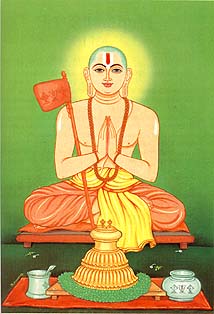
Ramanujachaya is accepted as one of the four core Jagatgurus in India.
The other three being Sri Adi Shankaracharya, Sri Madhvacharya and Sri
Nimbarkacharya. This year Sri Ramanujacarya’s appearance day falls
on March 21st 2010.
Sri
Ramanujachaya is accepted as one of the four core Jagatgurus in India.
The other three being Sri Adi Shankaracharya, Sri Madhvacharya and Sri
Nimbarkacharya. This year Sri Ramanujacarya’s appearance day falls
on March 21st 2010.
Sri Ramanujacarya was born in southern India. He is an incarnation of Laksmana. The word ‘anuja’ means ‘younger brother’. Rama-anuja refers to the younger brother of Lord Rama; therefore, he is Ramanuja. In Kali-yuga, he is the Acarya of the Sri (Laksmi) Sampradaya. His Guru was Sri Yamunacarya.
As a boy, Ramanuja was exceptionally intelligent. At a very young age, he knew all Sanskrit grammar (vyakarana), literature (sahitya), and all the deep conclusions of the Vedic scriptures.
Srila Bhaktisiddhanta Sarasvati Thakura Prabhupada took many teachings from him, such as the duties of the sannyasi, the duties of the disciple, and the etiquette of the Vaisnavas. He utilized one-hundred eight teachings of Sri Ramanujacharya.
In school one day his teacher, Yadavacarya, who was a follower of Advaitavada (the theory that the only truth is impersonal undifferentiated oneness), began to explain his understanding of the beauty of Sri Krsna’s eyes. In this regard Chandogya Upanisad uses the word ‘kapyasam.’ Yadavacarya explained that ‘kapi’ means ‘monkey’, and that the monkey’s rear-end (kapi-asam) is reddish on both sides. He concluded that Krsna’s lotus eyes are like a monkey’s rear-end. Hearing this, Ramanuja began to weep.
Later, when Ramanuja was massaging Yadavacarya’s feet, he very politely asked if he could say something about the verse. Yadavacarya assented. Ramanuja said, “Sir, the explanation you gave this morning for “kapyasam” is wrong. ‘Kapi’ can also be understood to mean ‘that which takes water from everywhere’. Who takes water? The sun. The word ‘asam’ also means ‘to blossom’, so the word ‘kapi-asam’ can be understood as ‘that which blossoms under the sun,’ or, in other words, ‘the lotus flower’. Thus, we can understand the verse to mean that the Lord’s eyes are as beautiful as the lotus flower.”
Ramanuja’s teacher became astonished, thinking, “If this boy is so knowledgeable at such a young age, what will he be when he is grown up? If he remains alive, this Adwaita philosophy will be finished.” His teacher then planned to murder him.
Thinking to trick Ramanuja, Yadavacarya told him that he was going to travel with all his students to do some preaching, and that Ramanuja should also accompany them. Ramanuja was a very sincere and innocent boy, so he didn’t understand his teacher’s intentions.
Then, when they were all in a very dense forest, they decided that this would be the time to murder him. Govinda, his cousin-brother, told him of their plan and urged him to quickly flee from there. In the middle of the night, Ramanuja told them that he was going to relieve himself and ran away.
Now alone, he suddenly saw a hunter, along with his wife, holding a hurricane lamp. The man asked him, “Where are you going?”
Ramanuja answered, “I am trying to get to Kancipuram.” The man replied, “We are also going there, so come with us.”
When he arrived at Kancipuram, his own village, which was very far away, those two persons disappeared. Ramanuja then began to weep. He understood that it was certainly the Supreme Personality of Godhead, Narayana Himself, along with His eternal consort, Laksimi-devi, who had saved his life.
Sometime later, Ramanuja’s teacher also came back to Kanchipuram. He had been thinking that perhaps a lion or tiger had eaten Ramanuja, and he was happy. However, when he arrived, he saw that Ramanuja was alive. He called him and told him to forget everything that had happened. Out of compassion for Yadavacarya and with a desire to deliver him, Ramanuja again began studying under his guidance.
After some years, Ramanuja converted Yadavacarya to Vaisnava philosophy, whereupon his teacher became his disciple. At one point thereafter, Ramanuja began hearing of the qualities of a great Vaisnava guru in South India by the name of Sri Yamunacarya, and he eventually became Sri Yamunacarya’s disciple.
Later on
he married, and his wife turned out to be very quarrelsome. Her behavior
was rude and uncooperative, and incidents would often take place which
he would have to tolerate great hardship.
One day, a disciple of Sri Yamunacarya named Kancipurna came to the house
of Ramanuja. He came there along with his wife by the order of his Gurudeva,
and began to associate with Ramanujacarya.
One day, when Ramanujacarya’s wife was drawing water from the well, Kancipurna’s wife was also there drawing water. Some water from the bucket of Kancipurna’s wife fell into Ramanuja’s wife’s bucket. As Kanchipurna hailed from a ‘low caste’ family, Ramanuja’s wife immediately became very angry and insulted the wife of Kancipurna with abusive language.
When Kancipurna returned, his wife told him of the incident at the well. Kancipurna was extremely hurt on hearing about this, and, without informing Ramanuja, he and his wife left that place and went to Sri Rangam. When Sri Ramanuja came to know that his wife’s behavior had offended a Vaisnava, he felt very bad and thought, “She is committing vaisnava-aparadha; she has such an offensive mentality. I must leave this lady as soon as possible.”
Soon, Sri Yamunacarya sent another disciple Purnacarya to bring Ramanuja to him in Sri Rangam. However, Yamunacarya was very sick at that time, and, by the time Ramanuja arrived in Sri Rangam, he had departed from the world.
Yamunacarya had left his body just before Ramanuja arrived. Ramanuja saw that many devotees were walking with the transcendental body of their beloved Gurudeva. All the disciples were weeping as they carried his body to be placed in samadhi.
Ramanuja said, “I have accepted Yamunacarya as my Gurudeva. I want to see his face.” Yamunacarya’s disciples stopped and lifted the cloth from his body. Ramanuja could see that three of Yamunacarya’s fingers were folded while the rest of his fingers were straight.
He inquired
from the disciples as to what this meant, and he wanted to know when it
happened. No one could answer. They said, “We didn’t notice
it before; it must have happened just now.”
Ramanuja stood silent and after some time he spoke, addressing Sri Yamunacarya’s
transcendental body. ‘I will write the Sri-bhasya commentary on
the Vedanta-sutra.” One of the fingers immediately became straight.
He then said, “I will take sannyasa,” and the second finger
relaxed. Lastly, he said, “I will preach the mission of my Gurudeva,
Yamunacarya”, at which time the last finger relaxed and became straight.
Seeing this, everyone present became astonished.
After Yamunacarya was given samadhi, Ramanujacarya was elected to become the next Acharya, as Yamunacarya’s successor. However he said, “I will not become the next acharya right away. Give me some time. Give me two years.” He then spent some time with each of the prominent disciples of Yamunacarya. He served them and heard from them what they had learned from their Gurudeva. Only after hearing from them for two years did he accept the post of Acharya.
Later, the King of that country, King Koluttunga II, heard that Ramanujacarya was very strongly preaching Vaishnava philosophy. Koluttunga II feared that the Shaiva Sampradaya would be finished. He sent a message telling Ramanujacarya to come at once for a debate.
Ramanujacarya and all his associates knew that the king wanted to kill him. One of his disciples Kuresh told him, “Gurudeva, please do not go. I will go in your place. Please give me your danda and sannyasa cloth.” Insisting, Kuresh took them from him and gave him his own white cloth. He told Ramanuja to leave that place at once. Then, having taken his Guru’s sannyasa cloth and danda, Kuresh went to the palace of the king.
In the palace there was a great debate, during which Kuresh defeated all the royal pandits. However, Kuresh was alone, so the king’s pandits told everyone that he had been defeated. They forcibly detained him, and only released him after blinding him by plucking out both of his eyes. He then began to search for his Gurudeva, who was now very far away. Fortunately, after some time, he came to the same village where Ramanujacarya was living.
In that village there were two disciples – one very rich and one very poor. Ramanujacarya told his disciples to go to the house of the rich devotee, because his group was more than fifty in total, and ask him to prepare prasadam and a place to stay for all of them.
Two of Ramanuja’s disciples went to the rich man’s house and gave him this message. The rich man felt extremely happy and became totally absorbed in preparing for the arrival of Ramanujacarya and all of his devotees. However, he didn’t come out again to share these plans with the two brahmacharis at the door. After waiting for some time, those disciples went back to Ramanujacarya and told him that they had gone to the house of the rich devotee, but he had left them waiting and had not come back to them. Ramanujacarya replied, “Oh, then we will all go to the house of the poor man.”
That very poor brahmana used to go and beg for food so that his wife could cook prasadam. Between them, they had only one piece of proper cloth, which his wife used, so when he would go begging, he would take the cloth of his wife.
On that particular day, after midday, he could not collect any more, and he decided to return home. In the meantime, before his return, Sri Ramanujacarya, with all of his disciples, suddenly came to his house. His wife was very happy to see her Gurudeva, but she also felt deeply ashamed because she had no proper cloth to wear. Sri Ramanuja understood this, and he gave her his own chadar. She wrapped this around herself and came in his presence.
After she gave a mat for her Gurudeva and his followers to sit on, she began to wonder, “How shall I arrange prasad for everyone?” She remembered that one of her neighbours, who was a rich businessman, was very attracted to her and had lusty desires for her. He had previously hinted to her of his desires, but she had always rejected his proposals. However, in her current predicament, she went to that man and told him that she would fulfill his desire.
She thought, “What is the use of my chastity if I cannot serve my Gurudeva? For my Gurudeva, I should be prepared to do anything.” She told that rich man, “I am ready to do what you want, but in return I want you to arrange many ingredients so that I can cook and give prasad to my Gurudeva and all of his disciples.” Hearing this, the rich man became very joyful and gave her more than what she wanted. Taking all that he gave her, she prepared excellent prasad for all the devotees, and everyone was happy.
While Ramanujacarya and all the devotees were resting after prasad, her husband returned home. He asked her, “Gurudeva and all his disciples have come. How are we going to arrange for their needs?”
She replied, “Everything has been done. There is nothing to worry about. They have all taken prasadam and are resting now.”
Her husband asked, “How did you make all these arrangements?”
She then told him all about the lusty neighbor. She said, “I was thinking that my Gurudeva has come; if I cannot serve him, then what is the use of my chastity? So I went and told that lusty man that if he would give me all the ingredients to make good Prasad bhog, then I would offer myself. He did as I asked, so now that it is night I must go to him.”
Her husband told her, “I will come with you.”
It was raining at the time, so they took an umbrella and went to the house of that rich person along with the maha prasad. The wife entered his home alone, and the man became very happy. The man asked her, “It is raining heavily tonight, and it appears you have come all alone. Didn’t anyone bring you?” She told him, “My husband came with me,” and she gave him the prasad remnants of Sri Ramanujacarya. The lusty man took those remnants and became totally transformed. He fell flat at the feet of the lady and begged her, “Forgive me. Please forgive me.”
The lady and her husband then returned to their house. The next day, their neighbour came to Ramanujacarya and prayed to him, “I want to be initiated by you.” Ramanujacarya then initiated him.
In the meantime, Kuresh arrived in the village of the poor devotee couple where Ramanujacarya was staying. Seeing Kuresh, Ramanujacarya called out his name. Kuresh went to his Gurudeva and wanted to take his darsana, but he had no eyes. Ramanujacarya put his hand over Kuresh’s wounded eyes and at once he could see again.
Afterward, Ramanujacarya went to North India. After travelling for a long time, he eventually arrived in Kashmir. He went to Sarada-pith, the place of Sarada-devi, where he came across the Bodhayana-bhasya (commentary) of Vedanta-sutra. This Bodhayana commentary contained Vaisnava philosophical conclusions. In the library at Sarada-pith he read that commentary, and in the night he took that book and escaped with Kuresh
They fled from there, but the Kashmiri pandits followed them. Finally, the pandits took the book back and returned to their own place. Ramanujacarya was very sorry, but Kuresh told him, “Gurudeva, do not be unhappy. I have also read that book, and I remember all its contents. I will write them down.” Later he did this, and he gave the writings to Ramanujacarya. Ramanujacarya then wrote his Sri-bhasya on Vedanta-sutra and fulfilled the three desires of his Gurudeva, Yamunacarya.
Sri Sri Jagatguru Ramanucharya Maharaj ki Jai !!
Jai Guru !!
Jai Sri Radhey !!